
Monday Meditation
Breathing Your Way Back Home
A Buddhist parable of a blind turtle inspires reflection on life’s rarity, balancing samsara’s struggles with presence and spiritual homecoming.

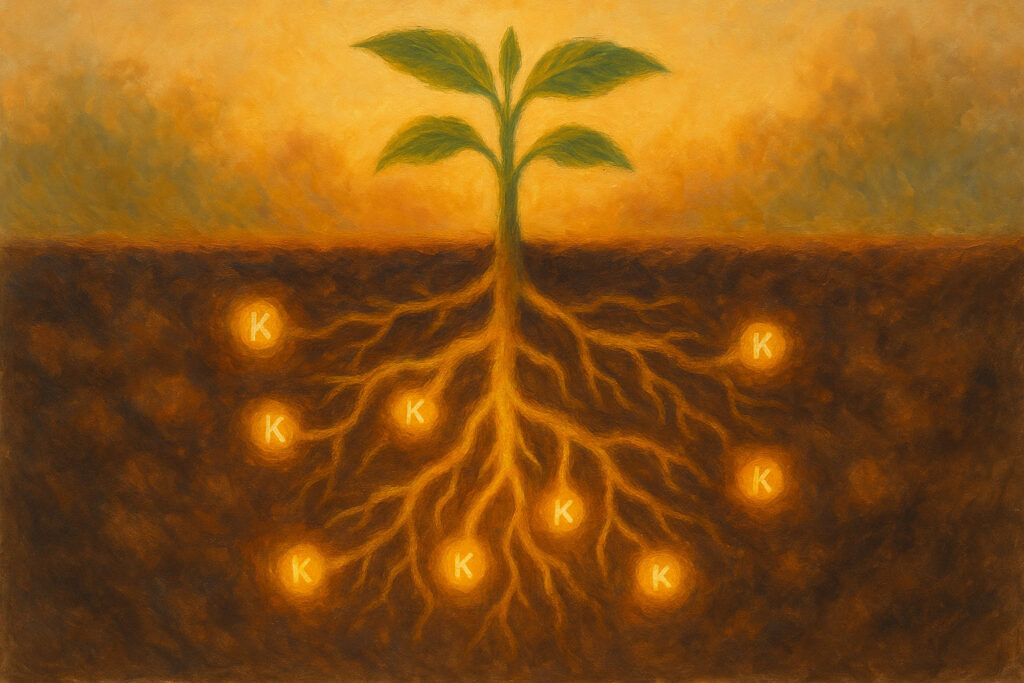
Every plant has an internal transportation system; a living network that moves minerals, water, sugars, and signals from cell to cell and organ to organ. Potassium is the gatekeeper of that entire system. It doesn’t build tissue or form structures; instead, it controls the movement of everything else that does.
When potassium is abundant and balanced, the plant’s highways stay open and traffic flows smoothly. When potassium is low, congestion forms; enzymes stall, stomata misfire, stress responses weaken, and the plant struggles to move the materials it needs to grow.
Below are the four ways potassium performs its role as the plant’s master transport element.
Potassium maintains the electrical charge difference across cell membranes that allows nutrients to flow in and out. That gradient is the “voltage” that powers nutrient transport. Without K, the gates stay partially closed.
When potassium is in the right range:
Many growers misdiagnose Ca or Mg deficiencies when the real issue is simply that potassium is too low to move those nutrients where they need to go. Potassium doesn’t just support uptake; it decides whether uptake can even occur.
In this sense, potassium acts like the plant’s customs officer; it checks the paperwork and decides what gets through.
Enzymes are the machines that move energy, manufacture sugars, build proteins, and cycle nutrients. Potassium activates and stabilizes over sixty of these enzyme systems. Without it, the biochemical conveyor belt stalls.
When the gatekeeper is present:
In cannabis, this is why optimized potassium nutrition can directly influence terpene expression; without K, the enzymatic “workers” cannot move materials through the metabolic pathways that lead to aroma and resin.
Potassium keeps the entire metabolic factory powered and moving.
Stomata are literal gates — tiny pores that regulate the movement of CO₂, oxygen, and water vapor. What controls whether these gates open or close? Potassium.
Guard cells take up potassium to open stomata; they release potassium to close them. It is one of the most elegant examples of K’s role as a transport regulator.
Because stomata govern the plant’s gas exchange and water movement, their function determines:
When potassium levels drop, stomatal gates become sluggish; they fail to open fully in the morning, close too slowly during heat, or oscillate unpredictably. The result is reduced CO₂ uptake, slower growth, and inconsistent transpiration — all transportation problems.
Potassium keeps the plant’s breathing gates synchronized with its metabolic needs.
Stress — heat, drought, cold, salinity — disrupts transport. Cells lose turgor, water shifts, enzymes degrade, and reactive oxygen species accumulate.
Potassium buffers all of these stresses by stabilizing the plant’s transport networks:
A plant with strong potassium nutrition can keep its doors open and its system moving even when conditions turn harsh. Without potassium, the transport system buckles under pressure.
Nitrogen builds leaves; phosphorus fuels energy; calcium builds structure. But potassium?
Potassium keeps the whole system open.
It is the traffic controller, the voltage holder, the gate opener, the movement manager. It ensures that nutrients, water, sugars, and signals can travel where they need to go.
For cultivators, this means:
If the plant looks slow, stressed, or underpowered — look first to the gatekeeper.

Potassium is widely available in natural materials, but not all forms behave the same in soil. Some release quickly; some become plant-available slowly; some add accompanying minerals that can shift soil chemistry. Below are the most reliable potassium sources for regenerative, living-soil, or organic-leaning cultivation systems.
Kelp is one of the most balanced and biologically active sources of potassium.
Why kelp stands out:
Kelp doesn’t just provide potassium; it improves the system that moves potassium. For growers building long-term soil structure and resilience — kelp is nearly always the first recommendation. Only downside with Kelp is the elevated levels of arsenic. Arsenic is present in soil. It’s unavoidable. But when you are cultivating a crop like cannabis where lab testing is involved, you need to be mindful of not bringing too much arsenic to the party. So easy does it on soluble kelp.
Analysis: 0–0–22 (K₂O) + 11% Mg + 22% S
Langbeinite is a natural mineral that provides a triple bonus: potassium, magnesium, and sulfur.
Best use cases:
Because Langbeinite supplies multiple cations, it should be added according to soil test data; overuse can compete with calcium uptake.
Wood ash is rich in potassium carbonate, often testing at 5–7% K. This is where Potash got its name. Back in the day, it was the “ash” from the “pot” over the fire that they applied to soil as they discovered the benefits of wood ash. Potash is often used to describe the group of potassium containing salts.
Pros:
Cons:
Wood ash is a powerful amendment for field soil — not typically for container media.
While compost varies widely, high-quality, microbially active compost often contains 1–2% potassium in plant-available and slow-release forms.
Compost contributes by:
Compost alone rarely solves a potassium deficiency, but it stabilizes potassium dynamics across seasons.
For living soil, regenerative beds, or outdoor cultivation:
This combination builds a soil system where the gatekeeper — potassium — is steady, balanced, and ready to move nutrients, water, and signals through the plant’s entire network.
If you would like to watch the video we made on Potassium, check it out here:
A Buddhist parable of a blind turtle inspires reflection on life’s rarity, balancing samsara’s struggles with presence and spiritual homecoming.

Pablo Neruda’s “Keeping Quiet” teaches stillness amid chaos, reminding us that silence, breath, and presence restore peace and balance.

Inspired by Rory McIlroy’s Masters win and local golf struggles, this meditation explores resilience, nerves, and the courage to persevere.