Trichoderma and Bacillus in Cultivation
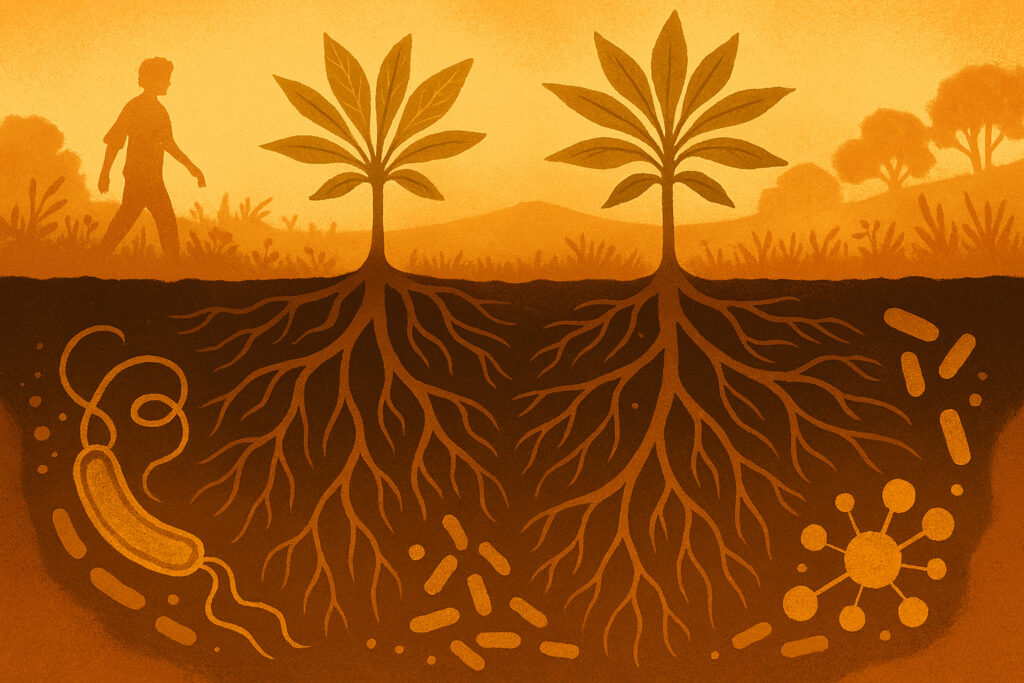
When we walk through a field, a forest or a garden, we usually notice only what is visible: the grasses, the canopy of green or the flowers. What we don’t see – what’s happening right at the root’s edge, in that tiny zone of soil called the rhizosphere – is every bit as important. Down there, life is moving in ways most growers never stop to imagine.
Among the billions of organisms jostling for space and food, two families of microbes stand out for their usefulness in cultivation: Trichoderma fungi and Bacillus bacteria. Both are considered “plant growth–promoting microbes” (PGPMs). Both protect roots from pathogens. Both mobilize nutrients that would otherwise remain locked away. And both, when introduced intentionally by growers, can tilt the balance of the rhizosphere in favor of healthier, more resilient plants.
Trichoderma
Trichoderma is a genus of fungi that lives on or near plant roots. They are not passive organisms. Instead, they actively interact with their environment in three ways:
- Parasitism of pathogens – Trichoderma can directly attack harmful fungi such as Pythium, Fusarium, or Rhizoctonia. They coil around the hyphae of the pathogen, penetrate it, and release enzymes that break down its cell walls. The result is a weakened or destroyed competitor.
- Secretion of enzymes – These fungi produce cellulases, chitinases, and other enzymes that decompose organic matter. By breaking down complex molecules into simpler ones, they release nutrients that plants and other microbes can use.
- Induced resistance – Perhaps most interesting, Trichoderma doesn’t just fight pathogens itself—it also primes the plant’s own defenses. Studies have shown that plants colonized by Trichoderma activate systemic resistance pathways, meaning they respond faster and stronger to subsequent pathogen attacks.
From a cultivation perspective, this makes Trichoderma a natural disease suppressant. Many seed companies and biofertilizer products already include Trichoderma spores for coating seeds or inoculating young transplants. Once established in the rhizosphere, they act like root guardians, creating a living barrier against infection.
Bacillus
Bacillus is a genus of Gram-positive bacteria, with several species widely used in agriculture. Unlike fungi, Bacillus species reproduce rapidly and form spores that allow them to survive drought, heat, and other stresses. Two species are especially important in cultivation: Bacillus subtilis and Bacillus amyloliquefaciens.
They benefit plants in several ways:
- Colonization of root surfaces – Bacillus forms biofilms on root hairs, essentially creating a protective layer. This prevents pathogens from gaining access to root tissue.
- Production of antibiotics and metabolites – Bacillus secretes lipopeptides and other antimicrobial compounds that inhibit fungi, bacteria, and even nematodes that might otherwise damage plants.
- Nutrient solubilization – Many soils contain phosphorus and other nutrients locked in insoluble forms. Bacillus releases organic acids that solubilize phosphorus, making it available to plants. Some species can also fix nitrogen in small amounts.
- Hormone production – Certain strains produce auxins and cytokinins, plant hormones that stimulate root growth and improve nutrient uptake.
For growers, Bacillus is usually applied through biofertilizers, compost teas, or inoculants. Because it forms durable spores, it is relatively easy to store, transport, and introduce into soil systems.
Application in Cultivation
For growers who want to integrate Trichoderma and Bacillus into their systems, there are a few practical considerations:
- Timing – Both microbes are most effective when introduced early, at seed or transplant stage. Inoculating at the root zone allows them to establish before pathogens take hold.
- Substrate – They thrive when there is adequate organic matter. Using compost, mulch, or cover crops ensures that the soil ecosystem has food sources to sustain microbial communities.
- Compatibility – Not all chemical inputs are compatible with living microbes. Broad-spectrum fungicides can wipe out beneficial fungi alongside pathogens. It is important to choose inputs that do not undo the benefits of inoculation.
- Rotation and diversity – Just like plants benefit from crop rotation, microbial communities benefit from diversity. Alternating between Trichoderma, Bacillus, and other beneficials like mycorrhizal fungi or Pseudomonas can create a resilient soil microbiome.
Research and Evidence
Peer-reviewed studies have documented the effectiveness of both groups. For example:
- Trichoderma has been shown to reduce root rot incidence by more than 50% in multiple crops, while also increasing nutrient uptake.
- Bacillus subtilis inoculation has been correlated with increased root mass and higher yields in vegetables, cereals, and fruit crops.
- Both have been shown to trigger gene expression in plants related to systemic resistance, essentially acting as “vaccines” that keep the plant’s immune system on alert.
The evidence base continues to grow, and these organisms are now considered standard tools in integrated pest and nutrient management.
Broader Perspective
What fascinates me most about Trichoderma and Bacillus is not just what they do in the soil, but what they symbolize. We often imagine we are “feeding plants,” but in truth, much of cultivation is about feeding microbes. We build environments where bacteria and fungi thrive, and they in turn nourish and protect the plants.
This shift in perspective changes how we think about growing. It’s not a one-to-one transaction of fertilizer into plant growth. It’s a community of interactions, where unseen allies do the work of unlocking nutrients, fighting pathogens, and stabilizing the ecosystem.
There’s a lesson here beyond the field. Growth – whether plant growth or human growth – rarely happens in isolation. Just as plants lean on microbial allies, we too lean on networks of support: family, teachers, mentors, friends. Our progress is never ours alone.
Conclusion
Trichoderma and Bacillus are not silver bullets. They don’t replace healthy soil practices, crop rotation, or balanced fertility. But when applied thoughtfully, they amplify the natural resilience of plants. They help roots defend themselves. They make locked-up nutrients accessible. They turn the rhizosphere into a safer, more fertile place.
In the end, they remind us that cultivation is about partnership. The health of our crops depends on relationships we can’t even see—microscopic threads of fungi and films of bacteria doing their quiet work in the dark. The more we learn to honor those relationships, the stronger and more resilient our garden will become.