Monday Meditation
Breathing Your Way Back Home
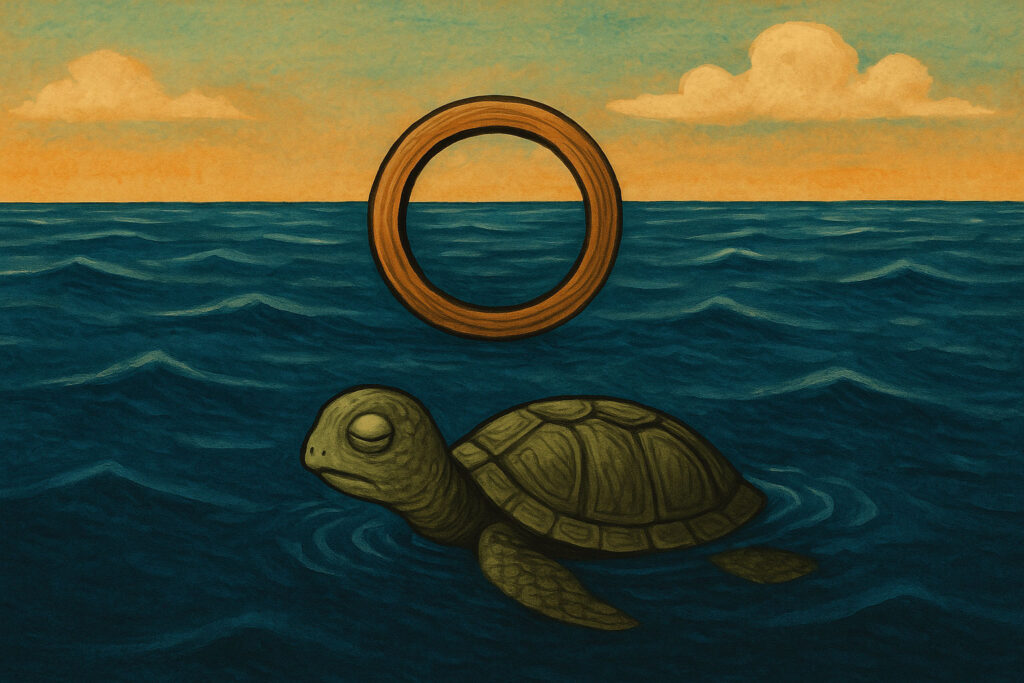
A Buddhist parable of a blind turtle inspires reflection on life’s rarity, balancing samsara’s struggles with presence and spiritual homecoming.


There’s a parable in the Pali Canon that has lived with me for years. The Buddha tells the story of a traveler who comes to a wide river. To cross, he gathers sticks and vines and lashes them into a makeshift raft. The traveler then paddles himself across to the far shore. Once he is safely on the other side, he has a choice: hoist the raft onto his head and carry it with him on the rest of his journey or leave it there? The answer is obvious and the Buddha’s teaching to his disciples is clear: continue without carrying. We have to learn to put down the tools, habits, and even beliefs that got us this far once their work is done and they no longer serve us. To cling to anything that isn’t needed is to weigh ourselves down. Easy to say, so much harder to live because we would rather stick with what we know in order to avoid the pain of change.
We all face this over and over as we cross threshold moments in our lives—graduations, marriages, promotions. Even if we see ourselves as capable and self-aware, at times we cling—sometimes desperately—to things that no longer serve us. It is not only overtly positive tools, but also unhealthy habits and ideas that can be ways we move across the rivers of our lives. Old strategies, old identities, substances, relationships that have run their course, even old wounds. I would argue that all of these things can become the metaphorical rafts we keep lugging around, convinced we still need them, even as we are no longer on the water where they once kept us afloat. We age out of them. No one would make fun of a two-year-old wearing diapers, but if you’re ten and still in Pampers, perhaps there’s a problem.
These transitional threshold moments come in many forms, but I find myself returning to the framework of what I call the doorway of the decade. Every ten years is a proving ground of life at that stage. We have a list of things that we are asked to face in that timeframe; to learn and integrate into our lives every ten years. Each decade has its own set of lessons and traumas—some small, some seismic. The wounds of our first ten years of life are clearly not the same as those of our second or third decade, but each phase leaves its unprocessed psychic residue.
The tools—those ‘rafts’—we use in each of those decades are distinct. And with each new decade, we face the same question: will we continue without carrying? If we have not prepared for those moments, the answer is probably not. Bringing awareness and skillful, mindful transformation to those milestones is no different than any other skill acquisition. You have to prepare so you have the ability and the insight to drop the raft and continue the journey.
And if our parents or teachers have not prepared us, the psychic weight begins to stack: layers of trauma and unconscious actions we eventually have to face. Will we do the work to clean the slate, or will we carry the raft of the past into the next chapter? If we do the work—through therapy, reflection and mindful practice—we absolutely can continue without carrying.

Carl Jung captured this tension with a simple, brutal truth: “There is no coming to consciousness without pain.” Coming into consciousness means becoming whole by facing what we have ignored, denied or projected. Spiritual training cuts emotionally; physical training burns physically. It’s painful. And humans are wired to avoid pain. We hesitate on the threshold hanging on to the raft because change hurts, even if we know that what lies on the other side of that pain is positive or healing.
I think it’s fair to say that hesitation and clinging usually wears one of three masks: fear of failure, fear of success, or fear of loss. Each is a different layer of the same threshold resistance. Failure tells us that we are not good enough, that to try and fall short or mess things up means I am nothing. Our egos will fight that moment tooth and nail to avoid that pain.
Fear of success scares us in a way that might be more subtle. I think the notion of success feels like it can be a relentless push that is all-consuming; where we have to constantly grind and grow into new responsibilities, new expectations, perhaps even a new identity. It chokes out our feeling of open possibility because we are forced into a conveyor belt of constant grind mode. More pain.
And fear of loss haunts us at the deepest level. When we lock in on moments that we have truly lost something—a loved one, a dear, old pet—we all can relate to that crushing feeling. Again we will do anything to avoid feeling loss. And if we end up stepping forward, it means we have to say goodbye and leave something behind; that represents some of the deepest pain, so we avoid it.
These three big fears are really just variants of change and pain avoidance. When we sense that big shift in energy, it absolutely has the power to freeze us at the edge of crossing. We get stuck. This is the ancient, archetypal tale of the hero who feels the pull to step beyond the known, yet freezes at the edge. Being alive means we are forced to constantly cross these invisible thresholds.
These moments will keep appearing as the rafts keep tempting us to cling. The practice is in choosing, again and again, to set them down. To trust that we were strong enough to build them, wise to use them, but brave enough to walk on without them. And here I am, mid-stream in my fifties, staring at my own threshold, looking to see if there is a raft I’m still carrying. This is the path. And I am asking again: Why do I hang on to things if they no longer serve me? If the answer is: because I never learned how to properly let go and I want to avoid pain, then the solution is clear: learn to continue without carrying.
Monday Meditation: On a slow ten count. Let’s ponder this: is there a raft you are carrying that no longer serves you? What would need to change in order to stop carrying that load? If you have anything that comes up from this meditation, write it down and work on an action plan to make the change you likely already know you need to make.
A Buddhist parable of a blind turtle inspires reflection on life’s rarity, balancing samsara’s struggles with presence and spiritual homecoming.
Pablo Neruda’s “Keeping Quiet” teaches stillness amid chaos, reminding us that silence, breath, and presence restore peace and balance.

Inspired by Rory McIlroy’s Masters win and local golf struggles, this meditation explores resilience, nerves, and the courage to persevere.