The Energy of the Storm:
“Not all storms come to disrupt your life. Some come to clear the path.”
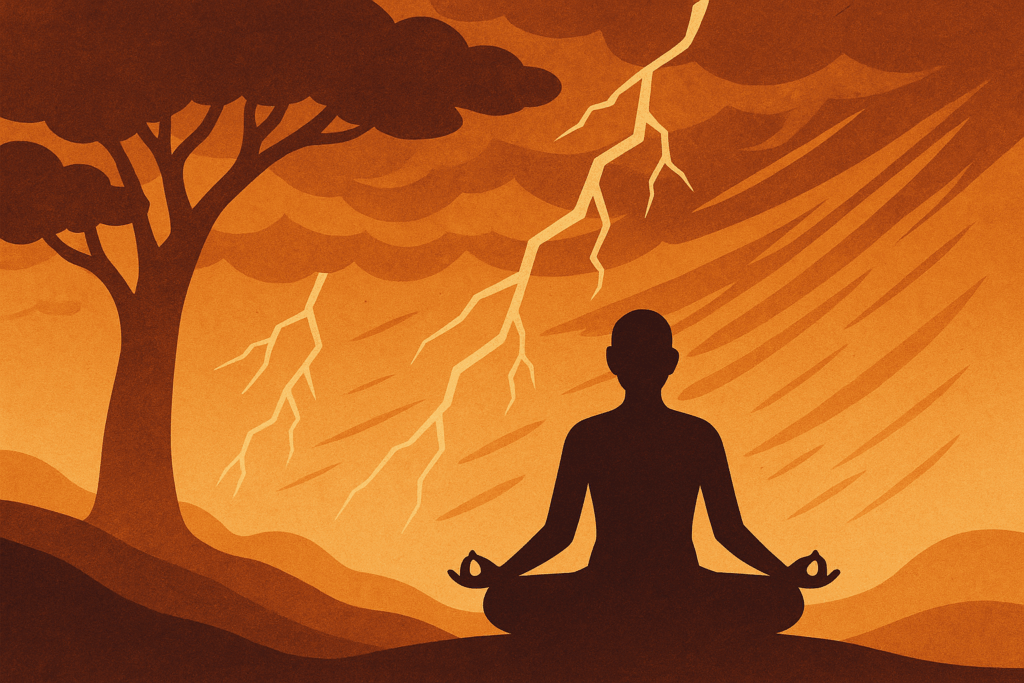
The story of the Buddha’s moment of enlightenment is well-known. On the night of his awakening, Siddhartha sat beneath the Bodhi tree with one vow: not to rise until he touched the root of suffering. As darkness thickened, Mara hurled storms of fear, desire, and doubt. There was the requisite thunder of demons, lightning of temptation—the full force of illusion swirled around him. Yet Siddhartha did not move.
When Mara challenged his right to sit there, he placed his hand upon the earth, and “the ground itself bore witness.” Through the long night he saw the endless cycles of birth and death, the truths of suffering and release. And when dawn broke, as the morning star rose, the storm dissolved. Siddhartha emerged as the Buddha—the Awakened One—reminding us that every storm, no matter how fierce, eventually passes, leaving clarity in its wake.
This story has been told again and again and I share it here because it captures so beautifully what I’ve been sitting with this week: how do we meet a convergence of forces? There are times when the energy and events in life collide all at once—the bad break at work, the transmission failing, the parking ticket, the illness. It stacks; it compresses. And it feels like a wrathful deity like Mara is at the door, throwing everything he has at you.
In the story of the Buddha’s awakening there is no epic fight scene where Siddhartha physically submits Mara, wrestling him to the ground. The battlefield is in the mind. The path to victory was through mental strength, founded in a simple but profound ability to control and calm the mind. To that end, our capacity to control and manage our mind and the way we respond to the energy of the moment is the crux of our ability to move through these challenging moments.
One of my favorite teachers, Debbie Crews, wrote a short but potent book called Energy in Motion. She teaches the mental game of golf, through the concept of energy—potential energy, intention and freedom in motion. Her insights and her teaching have stayed with me and like all transferrable knowledge, her teaching has crept into other areas of my life. When I’m caught in a maelstrom, I know that if I can meet the moment not with panic but with curiosity and radical acceptance, then I can move through it—and of course even learn from it. Just one of the many reasons why golf is such a beautiful crucible for life and the mental game of equanimity.
But there are many systems—ancient and modern—that train the mind just like we train the body. From the Buddha’s calm beneath the Bodhi tree, to the Stoics rehearsing loss, to mindfulness, breathwork, and EMDR therapies that reframe pain—each offers a discipline of attention and focus that leads to transformation. All carry the same invitation: to meet storms not with collapse, but with equanimity, curiosity, and steady courage.
We all know that surge of energy when bad news arrives: the quickening heart, the restless mind, the tight chest. It feels enormous. It feels like it could swallow us whole. But the embodied energy in that surge of events is entirely defined by our response to it. In that moment we have a choice: fear or curiosity. If we meet the moment of chaos and frustration with an open mind and curiosity, it can be transformational. Curiosity has a completely different feel to it. It is bright, open, spacious; filled with potential energy waiting to become something new. Fear, by contrast, feels low-ceilinged and claustrophobic, the mind racing in circles. The good news? We can train ourselves to choose curiosity more often than fear.
For me, one of those early trainings that has stayed with me for years has been Tonglen meditation. Tonglen is a Tibetan practice of breathing in suffering—visualizing it as a dark, heavy cloud—then transforming it with compassion and breathing out golden light. It’s pretty radical, kind of psychedelic and very powerful. It taught me that even the heaviest energy can be metabolized into something good.
Meditation isn’t just about chasing enlightenment. For me, and many practitioners, it’s training for the real storms of life. That’s why I keep coming back to a simple daily practice: ten conscious breaths. A slow four-count in, an eight-count out. Ten times. It resets everything. Longer meditation sits are beautiful, but these small micro-doses of presence—morning, noon, and night—are what help keep me steady. A reminder on my phone is the modern version of the ringing of the bell in the monastery. It is a call to stop, slow down and breathe.
CrossFit used to say: “train to not suck at life.” The point was simple: strength and resilience isn’t just for first responders or soldiers. Everyday people need strength to meet these moments too. We train the body not only to prevent injury and extend longevity, but to open up the full range of human experience—hiking mountains, swimming, playing, moving with joy. Physical strength expands what is possible in our lives.
The same is true for the mind. If we train the body daily, why not train the mind with the same devotion?
And today, I am saying it out loud: I am committing to going deeper in my meditation practice. One of my specific goals is to explore longer meditation blocks and to sit longer. I want to train for the centenarian Olympics of the mind.
So this week’s Monday Meditation is simple: After a slow ten count, think about all the ways you train your body to be strong and fit. Do you have the same regimen to train your mind? If not, start with a simple 10 count technique and build from there. Try the Tonglen technique and see how that feels. As Yoda says, “Do or do not. There is no try.”
Have a great week brotha!